

Barcelona · Neighbourhoods
Barcelona's most beautiful neighbourhoods
Barcelona has 10 districts and 73 official neighbourhoods. These are the best Barcelona neighbourhoods to visit, with what to see in each, how to get there by metro and how far they are from our table, on Carrer de Mallorca, next to La Pedrera.
01
La Dreta de l'Eixample, the Modernisme neighbourhood
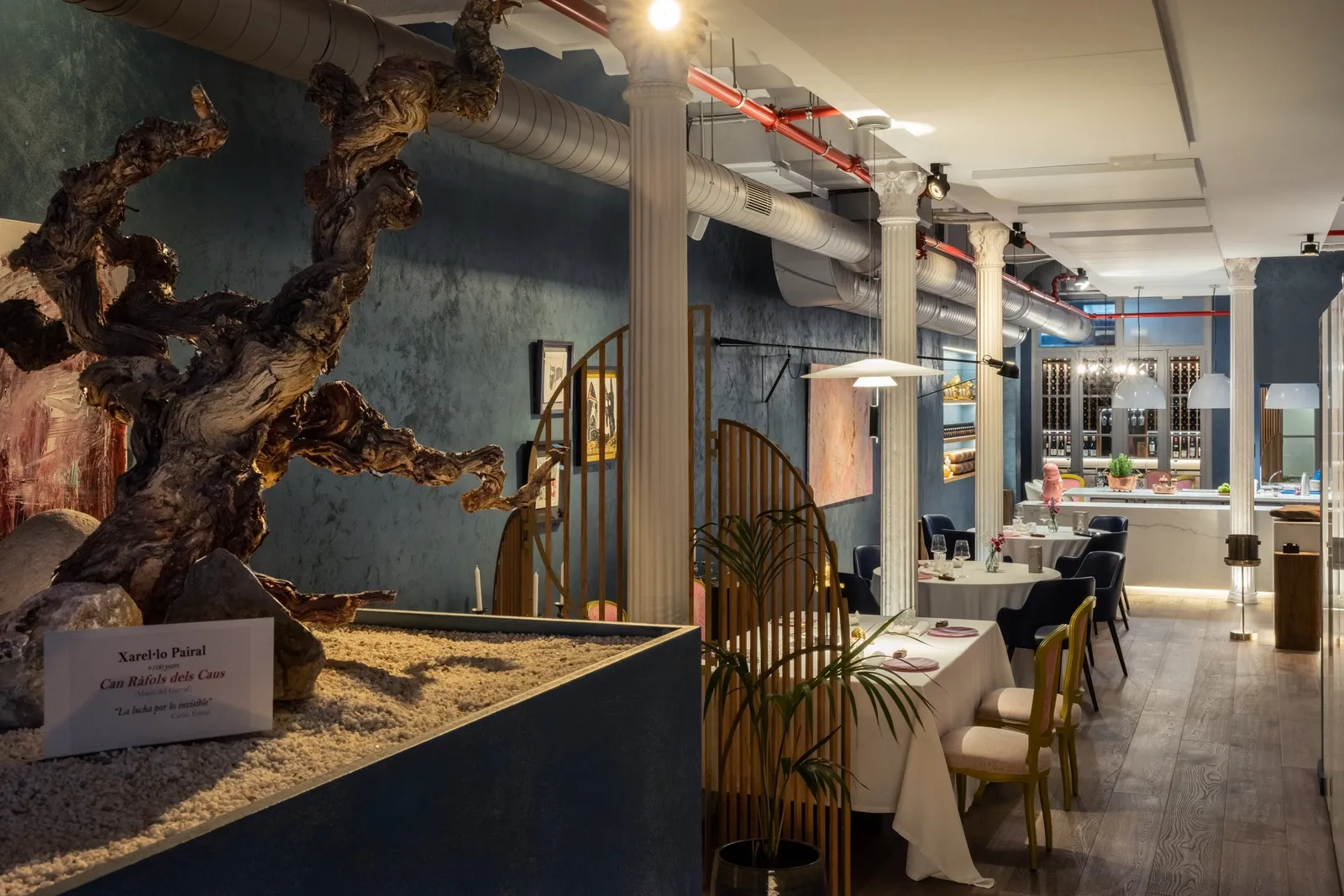
This is our neighbourhood: Espacio UMA is on Carrer de Mallorca, in the Dreta de l'Eixample (45,464 inhabitants according to the 2026 Padró). Here the grid of Ildefons Cerdà, approved in 1859, brings together some of the city's most famous Modernista houses, all less than half a kilometre from UMA as the crow flies.
The Eixample blocks are square, 113.3 metres on each side, with their corners cut off at 45°: these chamfered corners give each block its octagonal footprint. Ordinary streets are 20 metres wide.
Metro: Diagonal (L3, L5) and Passeig de Gràcia (L2, L3, L4); FGC Provença.
Casa Milà, La Pedrera
Gaudí, 1906–1912. UNESCO World Heritage Site since 1984. 0.17 km from UMA as the crow flies.
Passeig de Gràcia, 92
Casa Batlló
Between 1904 and 1906 Gaudí completely remodelled an 1877 building for Josep Batlló. World Heritage Site since 2005. 0.38 km as the crow flies.
Passeig de Gràcia, 43
Mansana de la Discòrdia
On the same stretch of Passeig de Gràcia as Casa Batlló stand Casa Amatller (Puig i Cadafalch) and Casa Lleó Morera (Domènech i Montaner): three Modernista architects on one block.
Casa de les Punxes
Puig i Cadafalch's Modernisme on the Diagonal, 0.35 km from UMA as the crow flies.
Avinguda Diagonal
02
La Sagrada Família
A neighbourhood in its own right within the Eixample (53,201 inhabitants); the basilica is 1.33 km from UMA as the crow flies. Metro: Sagrada Família (L2, L5) and Sant Pau | Dos de Maig (L5).
Basílica de la Sagrada Família
Foundation stone laid on 19 March 1882; Gaudí took over the project in 1883. Benedict XVI consecrated it as a minor basilica on 7 November 2010; the tower of Jesus Christ was crowned on 20 February 2026.
Recinte Modernista de Sant Pau
At the end of Avinguda de Gaudí, already in the Guinardó neighbourhood (Horta-Guinardó district): Domènech i Montaner began work in 1902 and his son completed it around 1930. World Heritage Site since 1997.
03
La Vila de Gràcia
It was an independent municipality until it was annexed to Barcelona in 1897, and it shows: squares with terraces, narrow streets and a village feel. After our own, it is the neighbourhood on this list closest to UMA, 0.77 km as the crow flies (51,477 inhabitants). Metro: Fontana (L3), Diagonal (L3, L5) and FGC Gràcia.
Casa Vicens
Gaudí's first house (1883–1885), for Manuel Vicens. World Heritage Site since 2005 and a museum since 2017.
C/ de les Carolines
Plaça del Sol, de la Vila and de la Virreina
The neighbourhood's squares, where life is lived out in the street.
Festa Major de Gràcia
In mid-August, from the 15th, with a contest of streets decorated by the residents (in 2026, from 15 to 21 August, with 23 streets competing).
Park Güell
A Gaudí work, World Heritage Site since 1984. It lies in the Salut neighbourhood, also in the Gràcia district, 2.28 km from UMA as the crow flies.
04
The Barri Gòtic
The heart of the old city (27,312 inhabitants), 1.62 km from UMA as the crow flies. Metro: Liceu (L3) and Jaume I (L4).
We tell the city's history, from Barcino to the present day, in History of Barcelona.
Catedral de Barcelona
Gothic construction began in 1298; the neo-Gothic façade and the crossing tower were completed in 1913.
Plaça Reial
Designed by Francesc Daniel Molina from 1848 onwards. The six-armed street lamps, from the late 1870s, were commissioned from Gaudí by the city council: one of his first public works.
Plaça del Rei (MUHBA)
Home of the Museu d'Història de Barcelona (MUHBA), with the Saló del Tinell.
05
Sant Pere, Santa Caterina i la Ribera: El Born
“El Born” is not an official neighbourhood but the part of la Ribera within Sant Pere, Santa Caterina i la Ribera (22,989 inhabitants). Its closest point, the Palau de la Música, is 1.26 km from UMA as the crow flies. Metro: Jaume I (L4), Urquinaona (L1, L4) and Arc de Triomf (L1).
Basílica de Santa Maria del Mar
Catalan Gothic, built between 1329 and 1383 and attributed to Berenguer de Montagut; consecrated in 1384.
Palau de la Música Catalana
By Domènech i Montaner (1905–1908) for the Orfeó Català, paid for by public subscription. World Heritage Site since 1997.
Museu Picasso
Opened on 9 March 1963 on Carrer Montcada; today it occupies five adjoining medieval palaces.
Mercat de Santa Caterina
An 1848 market, considered the city's first covered market, renovated by Enric Miralles and Benedetta Tagliabue with its undulating ceramic roof.
06
El Raval
The most populous neighbourhood in Ciutat Vella (50,863 inhabitants), west of La Rambla, 1.33 km from UMA as the crow flies. Metro: Liceu (L3), Drassanes (L3) and Sant Antoni (L2).
MACBA
Richard Meier's white building, opened on 28 November 1995 on Plaça dels Àngels.
Palau Güell
Eusebi Güell's house, by Gaudí (1886–1890). World Heritage Site since 1984.
C/ Nou de la Rambla, 3-5
El Gat de Botero
The Fernando Botero sculpture that the city council bought in 1987 and which, after several moves, reached the Rambla del Raval in 2003.
07
La Barceloneta
The seafaring neighbourhood, next to the beach (14,665 inhabitants), 2.29 km from UMA as the crow flies. Metro: Barceloneta (L4).
A planned neighbourhood
Laid out by the military engineer Juan Martín Cermeño in the mid-18th century (1753) to rehouse residents of la Ribera displaced by the construction of the Ciutadella.
Mercat de la Barceloneta
An 1884 market (Antoni Rovira i Trias), remodelled by Josep Miàs and reopened in March 2007.
Museu d'Història de Catalunya
In the Palau de Mar, the former General Trade Warehouses, the only building left from the old industrial port. Opened in 1996.
08
Poble-sec and Montjuïc hill
Montjuïc is not an official neighbourhood: almost all of the park lies within Poble-sec (40,136 inhabitants), in the Sants-Montjuïc district, 2.29 km from UMA as the crow flies. Metro: Paral·lel (L2, L3, with the Montjuïc funicular), Poble Sec (L3) and Espanya (L1, L3, FGC).
Palau Nacional (MNAC)
Built for the 1929 International Exposition; today it houses the Museu Nacional d'Art de Catalunya.
Fundació Joan Miró
A building by Josep Lluís Sert, opened on 10 June 1975.
Font Màgica
By Carles Buïgas for the 1929 Exposition.
Refugi 307 (MUHBA)
A Civil War air-raid shelter dug by local residents: some 400 metres of tunnels.
09
Sarrià and Sant Gervasi
Uptown Barcelona, a place of former villages and villas with gardens. Sarrià (24,937 inhabitants, 3.54 km as the crow flies) was the last municipality annexed to the city, in 1921. You get there on the FGC from Provença, 0.5 km from UMA. Next door, Sant Gervasi - la Bonanova (26,801 inhabitants) is home to the Torre Bellesguard.
Plaça de Sarrià
The centre of the old village, with the church of Sant Vicenç.
Torre Bellesguard
Gaudí, 1900–1909, on the site of King Martí l'Humà's palace.
Tibidabo
In the Vallvidrera, el Tibidabo i les Planes neighbourhood, in the same district: Enric Sagnier's Sagrat Cor church and the amusement park, opened in 1901.
10
Poblenou
The former industrial neighbourhood, now the heart of 22@, the innovation hub by the sea (34,736 inhabitants), 3.22 km from UMA as the crow flies. Metro: Poblenou and Llacuna (L4), Glòries (L1).
Rambla del Poblenou
The neighbourhood's main axis, with its terraces and street life.
Cementiri del Poblenou
The first cemetery outside the city walls (1775); destroyed in 1813, it was rebuilt by Antonio Ginesi and reopened in 1819. It holds the sculpture “El petó de la mort” (1930).
22@
A plan approved in 2000 to transform some 200 hectares of industrial land into an innovation district.
11
Horta-Guinardó: Horta and el Carmel
Horta was the municipality of Sant Joan d'Horta until it was annexed in 1904 (31,116 inhabitants, 3.98 km as the crow flies). In the same district, el Carmel has one of the best views of the city. Metro: Horta (L5), Mundet (L3) and El Carmel (L5).
Parc del Laberint d'Horta
A 1791 garden designed by Domenico Bagutti for the Marquis of Llupià; according to the city council, the oldest surviving garden in the city.
Búnkers del Carmel (MUHBA Turó de la Rovira)
A Republican anti-aircraft battery from 1937, now a MUHBA site and viewpoint, free to visit.
Barcelona's 10 districts
- Ciutat Vella
- 4 neighbourhoods · 115,829 inhabitants (Padró 2026)
- Eixample
- 6 neighbourhoods · 277,353 inhabitants (Padró 2026)
- Sants-Montjuïc
- 8 neighbourhoods · 196,040 inhabitants (Padró 2026)
- Les Corts
- 3 neighbourhoods · 83,773 inhabitants (Padró 2026)
- Sarrià-Sant Gervasi
- 6 neighbourhoods · 152,943 inhabitants (Padró 2026)
- Gràcia
- 5 neighbourhoods · 126,830 inhabitants (Padró 2026)
- Horta-Guinardó
- 11 neighbourhoods · 183,006 inhabitants (Padró 2026)
- Nou Barris
- 13 neighbourhoods · 183,280 inhabitants (Padró 2026)
- Sant Andreu
- 7 neighbourhoods · 158,284 inhabitants (Padró 2026)
- Sant Martí
- 10 neighbourhoods · 252,625 inhabitants (Padró 2026)
Where to eat nearby
Dining in the Dreta de l'Eixample
Espacio UMA is at Carrer de Mallorca 275, next to La Pedrera and Passeig de Gràcia. We serve three surprise tasting menus by chef Iker Erauzkin, in a single sitting for the whole dining room: at 13:30 (Monday, Thursday, Friday and Saturday) and at 20:30 (Thursday to Monday), with an optional pairing by our sommelier, Anna Yébenes. Menus from €86 per person (UMA Essence, in the dining room; Monday, Thursday, Friday and Saturday at 1:30 pm, and Monday and Thursday at 8:30 pm), VAT included; drinks extra.
Getting here and what is nearby: restaurant near La Pedrera.
C/ Mallorca 275, Bajos local 1A, 08008 Barcelona
By
The Espacio UMA team · Gastronomic restaurant in the Eixample
Written from Mallorca 275, next to La Pedrera: the Barcelona we recommend to guests who come to dine with us.
Sources
Facts checked on 4 November 2026.
- Ajuntament de Barcelona, Open Data: districts and neighbourhoods
- Ajuntament de Barcelona, Open Data: Padró municipal (pad_mdbas), 1/1/2026
- Enciclopèdia Catalana: Pla Cerdà
- Casa Milà, La Pedrera
- Casa Batlló
- Mansana de la Discòrdia
- Casa de les Punxes
- Basílica de la Sagrada Família
- Recinte Modernista de Sant Pau
- Casa Vicens
- Plaça del Sol, de la Vila and de la Virreina
- Festa Major de Gràcia
- Catedral de Barcelona
- Plaça Reial
- Plaça del Rei (MUHBA)
- Basílica de Santa Maria del Mar
- Palau de la Música Catalana
- Museu Picasso
- Mercat de Santa Caterina
- MACBA
- Palau Güell
- El Gat de Botero
- A planned neighbourhood
- Mercat de la Barceloneta
- Museu d'Història de Catalunya
- Palau Nacional (MNAC)
- Fundació Joan Miró
- Font Màgica
- Refugi 307 (MUHBA)
- Church of Sant Vicenç de Sarrià
- Torre Bellesguard
- Enciclopèdia Catalana: el Tibidabo
- Rambla del Poblenou
- Cementiri del Poblenou
- 22@
- Parc del Laberint d'Horta
- Búnkers del Carmel (MUHBA Turó de la Rovira)
- Districte de Gràcia: history (1897 annexation)
- Ajuntament: a hundred years since Sarrià's annexation (1921)
- Arxiu Municipal: Sant Joan d'Horta (1904 annexation)
- Cerdà Plan (113.3 m blocks and 20 m streets)