

Barcelona · History
History of Barcelona, from Barcino to today
More than two thousand years fit into a single walk. This is the history of Barcelona in brief, told through the dates that explain it, with the places where you can still see them: from the Roman columns of Mons Taber to Cerdà’s grid, where we cook today.
01
Barcino, the Roman colony
Barcelona began as Colonia Iulia Augusta Faventia Paterna Barcino, founded in the time of Augustus on Mons Taber, a low rise by the sea. The Barcelona History Museum (MUHBA) places it in the 1st century BC; most authors give a date around 10 BC.
More of that walled city survives than you might think: columns, stretches of wall and whole streets beneath the ground of the Barri Gòtic.
Temple of Augustus
Roman · Barri Gòtic
Four Corinthian columns from a 1st-century BC temple dedicated to the imperial cult, at the highest point of Mons Taber. It is one of the MUHBA sites.
C/ Paradís, 10
MUHBA Plaça del Rei
Roman, Visigothic and medieval · Barri Gòtic
More than 4,000 m² of remains beneath the square: streets and buildings of Barcino, the 7th-century Visigothic city and, above them, the old palace of the count-kings.
Plaça del Rei, s/n (entrance on C/ del Veguer)
02
Visigoths, al-Andalus and the Franks
In 415 the Visigothic king Ataulf settled in Barcino with his court, and was murdered there that same year. Around 717–720 the city became part of al-Andalus; the sources do not allow the exact year to be fixed.
In 801 Louis the Pious, King of Aquitaine and son of Charlemagne, took Barcelona after a siege, and Bera became the first Frankish count. Between 878 and 897 the county was ruled by Wilfred the Hairy (Guifré el Pilós), whose descendants would inherit it. In 985 Almanzor stormed and sacked the city, and around 987–988 Count Borrell II stopped renewing his vassalage to the new Frankish king, Hugh Capet: this is regarded as the start of the county’s de facto independence.
03
The county and the Crown of Aragon
In 1137, at Barbastro, Ramon Berenguer IV agreed his betrothal to Petronilla of Aragon, who was barely a year old; the wedding took place in Lleida in 1150. From that dynastic union came what would be called the Crown of Aragon. Their son, Alfonso the Chaste, inherited the county in 1162 and, shortly afterwards, the kingdom when his mother renounced it: he was the first ruler of Barcelona and Aragon at the same time.
The city governed itself: in 1249 James I granted the privilege usually taken as the origin of municipal government, and in 1265 the council was fixed at a hundred leading citizens, the Consell de Cent, which would govern Barcelona until 1714. This was the age of the great Gothic churches.
Basílica de Santa Maria del Mar
Catalan Gothic · La Ribera · El Born
Built in just 54 years, from 1329 to 1383, which is rare for a great Gothic church. It is the church of the Ribera, the old seafaring quarter.
04
1714: the siege and the Nueva Planta
In the War of the Spanish Succession, Barcelona held out through a siege of some 13 months and fell to the Bourbon troops on 11 September 1714. The Nueva Planta decree of 16 January 1716 abolished the existing self-governing institutions, the Consell de Cent among them. That same year work began on the military Citadel (Ciutadella), for which part of the Ribera district was demolished.
El Born. Museu d'Història de Barcelona
1714 and the 19th century · El Born
Beneath the old Born market (Josep Fontserè, opened in 1876), the remains of some 55 houses and streets demolished after 1714 to build the Citadel came to light in 2002.
Plaça Comercial, 12
05
Down with the walls: Renaixença and Eixample
The 19th century changed the scale of the city. The Renaixença took Aribau’s ode “La pàtria” (1833) as its symbolic starting point, and in 1859 the Floral Games (Jocs Florals) were restored. Between 1854 and 1856 the medieval walls were pulled down, opening up the plain for the city to grow.
Ildefons Cerdà’s Extension Plan was approved by royal decree on 7 August 1859 and confirmed on 31 May 1860, even though the City Council preferred Rovira i Trias’s plan. So the Eixample was born: the grid of streets that today links, among many other places, Passeig de Gràcia and the Sagrada Família, and where Carrer de Mallorca runs.
In 1869 the Citadel was handed over to the city and demolished; in its place came the park that hosted the 1888 Universal Exhibition.
What to see today in each neighbourhood, from the Eixample to Gràcia or el Born, is in The most beautiful neighbourhoods in Barcelona.
Parc de la Ciutadella and Arc de Triomf
18th century and 1888 · Ciutat Vella
The Bourbon fortress became the park of the 1888 Exhibition, with the Arc de Triomf as its gateway.
Passeig de Lluís Companys (Arc de Triomf)
Cerdà’s grid, approved in 1859, is still the plan you walk through in the Eixample.
06
Modernisme and the modern city
On 19 March 1882 the foundation stone of the Sagrada Família was laid, to a design by Villar; Gaudí took over the work in 1883. Modernisme reached its height in the early 20th century: Domènech i Montaner built the Palau de la Música Catalana (1905–1908) and Gaudí the Casa Milà, La Pedrera (1906–1912), in the Eixample.
Not everything was splendour. In 1909 the Tragic Week, an anti-militarist and anticlerical revolt after reservists were shipped off to Morocco, ended with churches and convents burned and five people executed by firing squad. Twenty years later, the 1929 International Exhibition transformed Montjuïc; it opened on 19 May 1929 and closed on 15 January 1930.
Casa Milà, La Pedrera
Modernisme · Dreta de l'Eixample
Apartment building by Gaudí for Pere Milà, on Cerdà’s grid. A UNESCO World Heritage Site since 1984.
Passeig de Gràcia, 92 (corner of C/ Provença)
07
Civil War, democracy and the Olympic Games
During the Civil War (1936–1939) the city suffered air raids and more than a thousand shelters were built; Franco’s troops entered Barcelona on 26 January 1939.
With democracy, the first municipal elections were held on 3 April 1979, and on 19 April the first democratic city council was formed, with Narcís Serra as mayor. The 1992 Olympic Games, from 25 July to 9 August, transformed the waterfront and Montjuïc, and in 2004 the Universal Forum of Cultures opened a new site at the mouth of the Besòs.
MUHBA Refugi 307
Civil War · Poble-sec
An air-raid shelter dug by local residents into the slope of Montjuïc: almost 400 metres of tunnels. Guided visits only.
C/ Nou de la Rambla, 175
The history of Barcelona in 12 dates
- c. 10 BC
- Roman colony of Barcino
- 801
- Frankish conquest: Barcelona becomes a county
- 987–988
- De facto independence of the county
- 1137 · 1162
- Union with Aragon; Alfonso the Chaste, first ruler of both
- 1249–1265
- Municipal government and the Consell de Cent
- 1329–1383
- Santa Maria del Mar
- 1714 · 1716
- Fall of Barcelona and the Nueva Planta
- 1854–1856
- The walls come down
- 1859–1860
- Cerdà Plan: the Eixample
- 1888 · 1929
- Universal (1888) and International (1929) Exhibitions
- 1906–1912
- Gaudí’s La Pedrera
- 1979 · 1992
- Democratic city council and the Olympic Games
Where to eat nearby
In Cerdà’s Eixample, next to La Pedrera
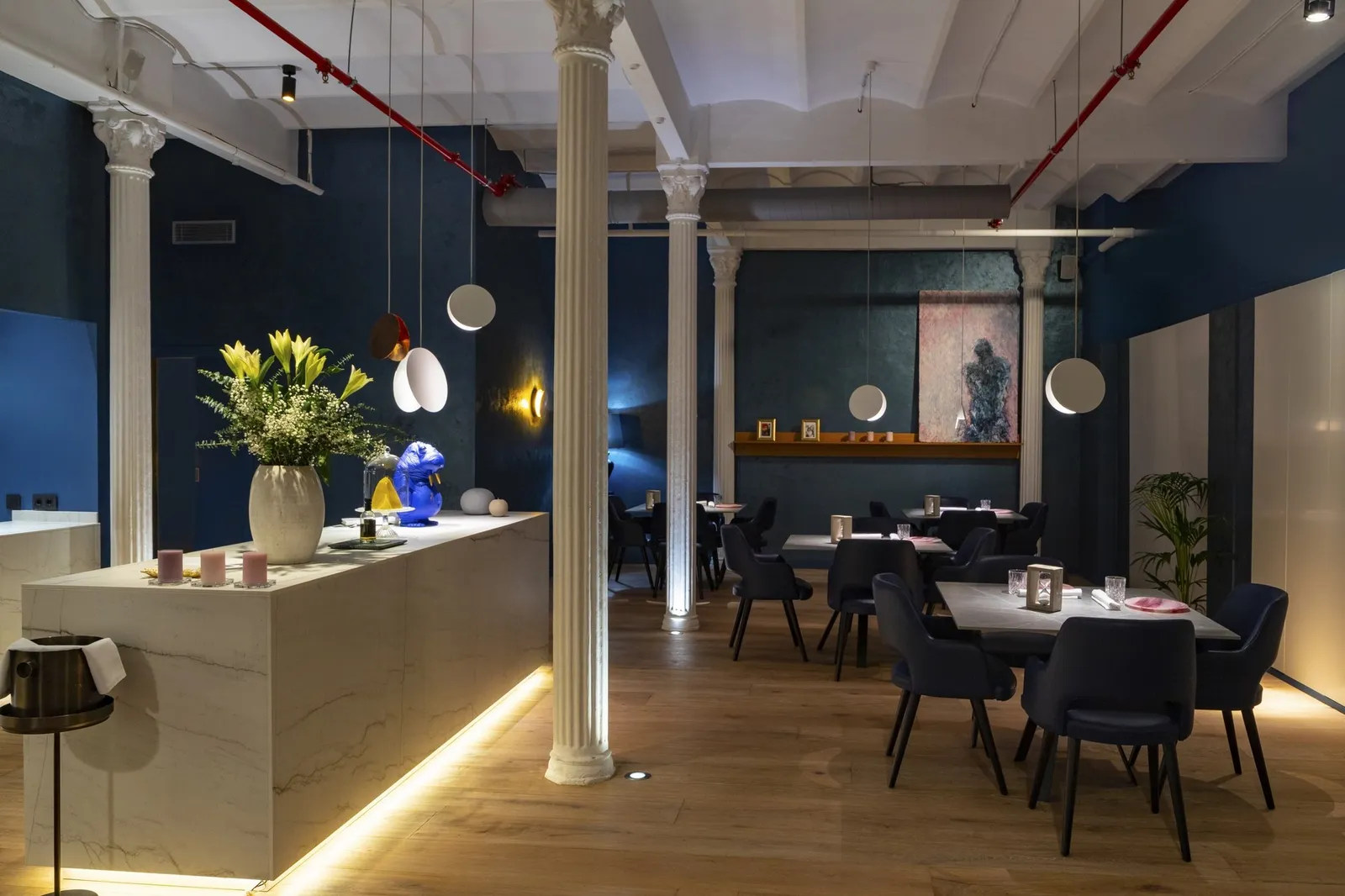
Espacio UMA is on Carrer de Mallorca, in the grid that grew out of the Cerdà Plan, next to La Pedrera and Passeig de Gràcia. A fine way to end a walk through the city’s history: three surprise tasting menus by chef Iker Erauzkin, served to the whole dining room at the same time, with an open kitchen. Menus from €86 per person (UMA Essence, in the dining room; Monday, Thursday, Friday and Saturday at 1:30 pm, and Monday and Thursday at 8:30 pm), VAT included; drinks extra.
Getting here and what is nearby: restaurant near La Pedrera.
C/ Mallorca 275, Bajos local 1A, 08008 Barcelona
By
The Espacio UMA team · Gastronomic restaurant in the Eixample
Written from Mallorca 275, next to La Pedrera: the Barcelona we recommend to guests who come to dine with us.
Sources
Facts checked on 4 November 2026.
- MUHBA: Barcino, remains of the ancient city
- MUHBA Temple d'August
- MUHBA Plaça del Rei
- Enciclopèdia Catalana: Ataülf
- Enciclopèdia Catalana: la Catalunya musulmana
- Enciclopèdia Catalana: comtat de Barcelona
- Enciclopèdia Catalana: la formació d'una corona, 1137–1151
- Arxiu Municipal de Barcelona: orígens medievals (Consell de Cent)
- Enciclopèdia Catalana: Santa Maria del Mar
- Enciclopèdia Catalana: Guerra de Successió i Nova Planta
- Universitat de Barcelona: the old city and the walls
- Enciclopèdia Catalana: Pla Cerdà
- Enciclopèdia Catalana: Exposició Universal de 1888
- Sagrada Família: història del temple
- Enciclopèdia Catalana: Casa Milà
- Palau de la Música Catalana: heritage
- Enciclopèdia Catalana: Setmana Tràgica
- Enciclopèdia Catalana: Exposició Internacional de 1929
- Ajuntament de Barcelona: Barcelona, gener de 1939
- MUHBA Refugi 307
- Arxiu Municipal: first democratic city council (1979)
- Britannica: Barcelona 1992 Olympic Games
- betevé: what happened in Barcelona in 2004
- Enciclopèdia Catalana: El Born Centre de Cultura i Memòria